Pierre Charles L'Enfant
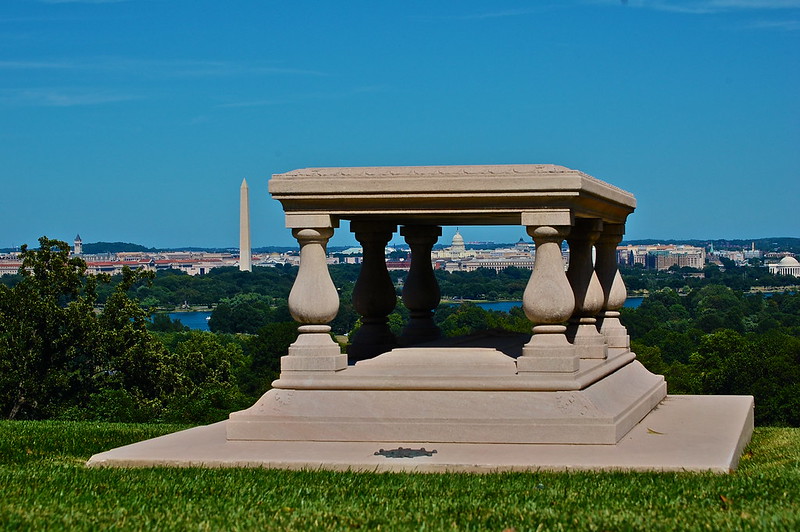
Section 2, Grave S-3
Pierre Charles L'Enfant was an engineer, architect and city planner who served in the Continental Army during the American Revolution and subsequently designed the spatial plan for Washington, D.C.
Born in Paris in 1754, L'Enfant was the son of painter Pierre L'Enfant. He studied under his father at the Academie Royale de Peinture et de Sculpture (Royal Academy of Painting and Sculpture), one of France's most prestigious art institutions. In September 1776, he left France in order to join the American Revolution, serving first with the French Colonial Troops and then as an officer in the Continental Army Corps of Engineers. He served on George Washington's staff at Valley Forge, suffered a serious injury at the Siege of Savannah (1779), and spent six months as a prisoner of war after being captured by the British during the battle for Charleston (1780). Following his release, he continued serving in the Continental Army Engineers Corps.
Discharged in 1784, when the Continental Army disbanded, L'Enfant established his reputation as an architect, receiving major commissions in Philadelphia and New York. He also designed the insignia of the Society of the Cincinnati, an organization of Continental Army officers. In 1789, he wrote President George Washington with a proposal to design the "federal city" that would be the new nation's capital; less than a year later, Washington appointed him to design what would become Washington, D.C. The L'Enfant Plan (whose original copy resides at the Library of Congress) envisioned Washington, D.C. as a four-quadrant grid, with north-south and east-west streets crossed by grand diagonal avenues. In conceptualizing the city plan, L'Enfant drew upon traditional European urban planning elements, along with neoclassical designs to emphasize the democratic character of the United States.
Despite his later renown for his design of Washington, D.C., L'Enfant died in poverty on June 14, 1825. He was originally buried on a farm in Prince George's County, Maryland, owned by his friend and benefactor William Dudley Digges. During the late 19th century, however, L’Enfant’s public reputation gradually underwent rehabilitation. Concerned about Washington, D.C.’s seemingly disorganized development, a loose coalition of influential architects, city planners and businessmen led efforts to revive L’Enfant’s records and work; in 1887, the Library of Congress published a facsimile of his plan for the nation’s capital; and French ambassador Jules Jusserand, a close acquaintance of President Theodore Roosevelt, advocated for the United States to honor French citizens’ contributions to the American Revolution.
In May 1908, Congress appropriated $1,000 for a more suitable burial site in Arlington National Cemetery. In December 1908, the secretary of war approved a site, selected by the Board of Commissioners of the City of Washington, located between the General Philip Sheridan Memorial Grave and the Arlington House flagstaff. On April 22, 1909, L'Enfant's remains were exhumed from the Digges farm, placed in a casket draped with the American flag and temporarily transferred to vault at a nearby cemetery. Six days later, on the morning of April 28, L’Enfant’s casket arrived in Washington, D.C. and lay in state at the U.S. Capitol—making him the first foreign national accorded this honor. Later that day, the casket was transported with military escort to Arlington National Cemetery, where L'Enfant received a full military honors funeral. His remains were reinterred on a hillside overlooking the city that he had designed.
On May 22, 1911, President William Howard Taft presided over the ceremony to dedicate a monument at L'Enfant's gravesite. Hundreds of guests attended the ceremony, including Ambassador Jean Jules Jusserand of France, members of Congress, Supreme Court justices and high-ranking military, diplomatic and city officials.
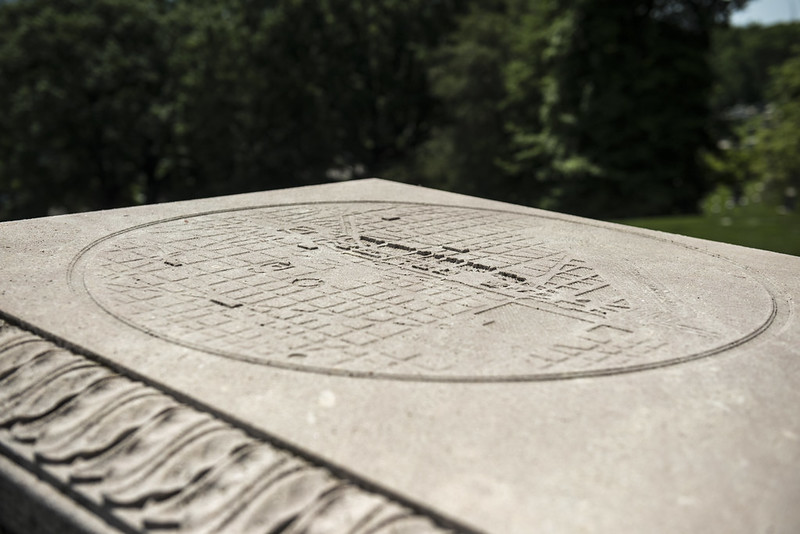
Made of white marble, the monument consists of four slabs supported on six posts, with an oak leaf at each corner and a scalloped design around the edges. The east end (facing Arlington House) depicts L'Enfant's plan for Washington, D.C., with an epitaph below.