United States Soldiers’ and Airmen’s Home National Cemetery
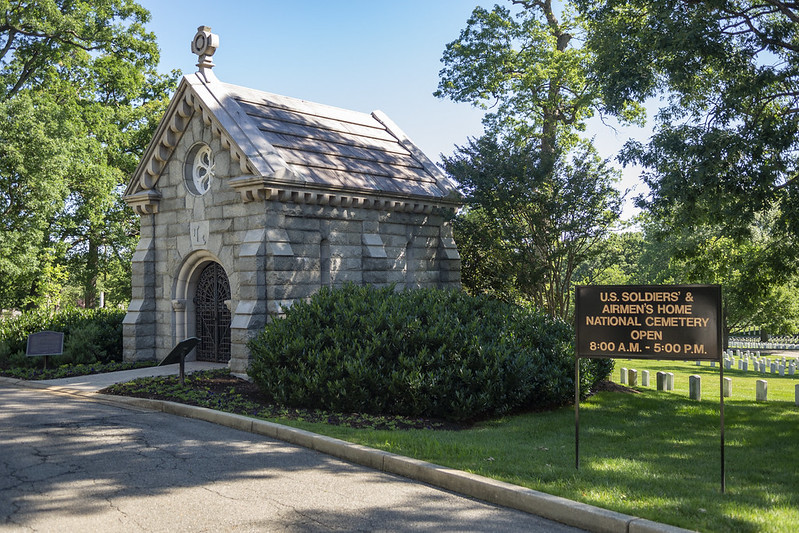
The United States Soldiers’ and Airmen’s Home National Cemetery, one of the country’s oldest national cemeteries, is located just north of the Armed Forces Retirement Home (commonly referred to as the Soldiers’ and Airmen’s Home) in Washington, D.C. It is the final resting place of more than 14,000 veterans, including many who fought in the Civil War and 21 recipients of the Medal of Honor, the nation’s highest military decoration. Along with Arlington National Cemetery, Soldiers' and Airmen's Home National Cemetery is one of two national cemeteries maintained by the Department of the Army.
During the Civil War, churches and other public buildings around Washington were commandeered for use as military hospitals to care for wounded troops or those stricken with illness on the front lines. Just days after the First Battle of Bull Run in July 1861, the commissioners of the United States Military Asylum offered six acres of land at the north end of the home’s grounds as a burial ground for soldiers and officers. The first burials were conducted later that summer.
From 1861 to 1864, the cemetery accepted thousands of soldiers’ remains from across the nation, which quickly filled its six acres. An 1874 report on the condition of the cemetery noted that it contained more than 5,600 interments, including 278 unknowns, 125 Confederate prisoners of war and 117 civilians (relatives of the deceased and employees of the home). In 1883, nine acres were added to the grounds, bringing the cemetery’s size to nearly 16 acres.
The imposing main gate at the west corner of the cemetery consists of four pairs of Doric order columns, each inscribed with the name of a well-known U.S. general, including George Washington, Winfield Scott and Ulysses S. Grant. Just inside the gate, you will see the two-story superintendent’s lodge, built around 1867, and the Logan Mausoleum, the most prominent monument at the cemetery. The granite, Norman-style mausoleum, designed by prominent federal architect Alfred B. Mullett, houses the remains of Maj. Gen. John A. Logan and his family.
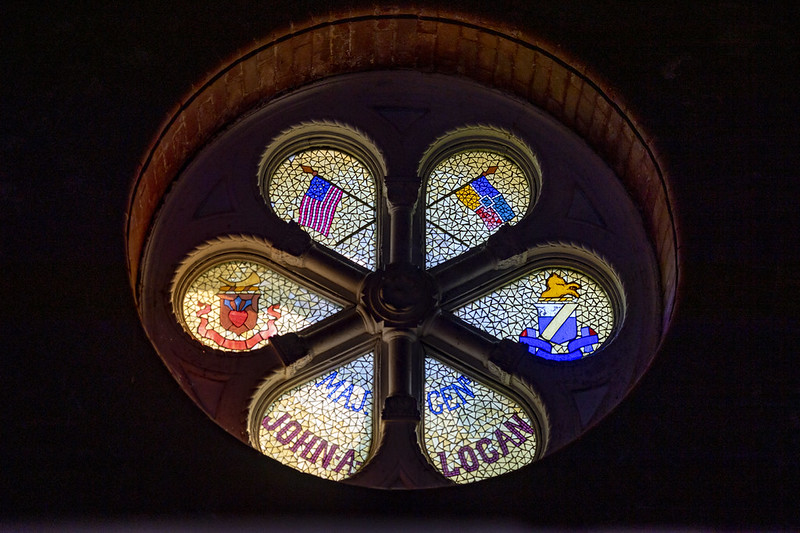
Logan served in the U.S. Army during the Mexican-American War and was later elected to Congress as a representative from his home state of Illinois. At the outset of the Civil War, Logan organized a volunteer regiment and eventually rose to the rank of major general. He returned to Congress after the war, winning election to the Senate three times. In 1884, he ran as James Blaine’s vice-presidential candidate on the Republican ticket, which lost the election to Grover Cleveland.
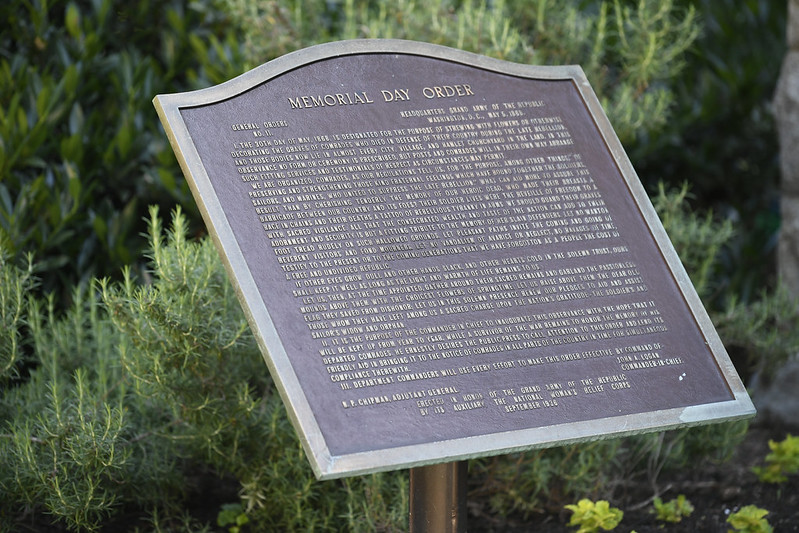
Logan also played a key role in creating the holiday we now know as Memorial Day. In 1868, as commander of the Grand Army of the Republic (GAR)—a prominent and influential organization of Civil War Union veterans—he issued a proclamation declaring May 30 as a national day of remembrance to honor fallen service members. That May, the first official, national “Decoration Day” ceremony took place at Arlington National Cemetery, so called because people visited gravesites and decorated them with flowers. Within a decade, Americans used the terms "Decoration Day" and "Memorial Day" interchangeably. It was not until 1971, however, that the day received its official designation as Memorial Day, and the date changed to the fourth Monday of May.
Born out of Logan’s advocacy for veterans, Memorial Day remains a uniquely American tradition, rooted in the Civil War and imprinted onto the landscapes of Arlington National Cemetery and Soldiers’ and Airmen’s Home National Cemetery.
Plan Your Visit
► 21 Harewood Rd. NW, Washington, D.C. Open daily, 8 a.m. to 5 p.m. Questions? Call 877-907-8585.
► Download our ANC Explorer app for a walking tour of the cemetery, or simply to learn about some of those buried there.
► While visiting, please be mindful that national cemeteries are hallowed ground. Be respectful to fallen service members and their families.