AUTHORS

Author: Army National Military Cemeteries Public Affairs Office
63 found

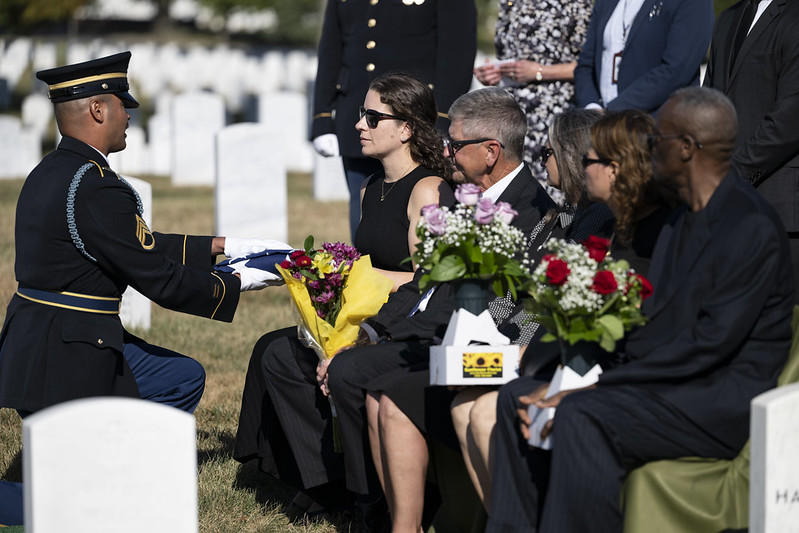
“Full Circle”: Secret Service Agent Clint Hill Laid to Rest at Arlington National Cemetery

On Nov. 22, 1963, President John F. Kennedy’s motorcade was traveling through Dealey Plaza in Dallas, Texas, when the crack of a gunshot suddenly pierced the noise of the crowds lining the street. Within mere seconds, Secret Service agent Clint Hill jumped from the car following behind, leapt onto the trunk of the president’s convertible limousine, pulled himself inside, and threw his body, as a human shield, on top of the president and first lady. A second bullet had fatally struck the president in the head. Yet by all accounts, Hill’s swift and fearless actions likely saved Jacqueline Kennedy’s life. During the next four days, he would remain steadfastly by the grieving first lady’s side — from the limousine to the hospital in Dallas to Arlington National Cemetery, where President Kennedy was buried on Nov. 25.  

Vietnam Veteran Who “Loved History” Laid to Rest at Historic Soldiers’ and Airmen’s Home National Cemetery

On June 10, 2026, U.S. Navy Radioman Petty Officer 1st Class Louis Rine was laid to rest at the historic United States Soldiers’ and Airmen’s Home National Cemetery (SAHNC) in Washington, D.C. A Vietnam War combat veteran, Rine spent his last years residing at the nearby Armed Forces Retirement Home (commonly known as the Soldiers and Airmen’s Home). Because only residents of the home are eligible for burial at the cemetery, funerals such as Rine’s rarely take place at SAHNC — which, along with Arlington National Cemetery, is one of two national cemeteries maintained by the Department of the Army.  

For Old Guard Soldiers, “Flags In” Is a Personal Mission

In the early morning dawn on May 21, 2026, soldiers of the 3d U.S. Infantry Regiment (The Old Guard) marched into Arlington National Cemetery (ANC), their rucksacks packed with small American flags. Their mission: To honor America’s fallen heroes by placing a flag in front of each headstone and columbarium column — approximately 250,000 at ANC and 13,500 at the Soldiers’ and Airmen’s Home National Cemetery in Washington, D.C. This tradition, known as “Flags In,” takes place annually at both cemeteries on the Thursday before Memorial Day. 

Arlington National Cemetery Commemorates “America 250” with History Hike

How does Arlington National Cemetery (ANC) connect to the American Revolution, which began 88 years before ANC became a national cemetery in 1864? This question was answered during a special “America 250” public walking tour on April 10, which helped kick off Army National Military Cemeteries’ (ANMC) commemoration of the nation’s 250th birthday — marked by the signing of the Declaration of Independence on July 4, 1776.  

King Charles III and Queen Camilla Honor a Shared History of Service and Sacrifice

On April 30, 2026, cannons fired a 21-gun salute as King Charles III and Queen Camilla entered Arlington National Cemetery (ANC) for an Armed Forces Full Honors Wreath-Laying Ceremony at the Tomb of the Unknown Soldier. The ceremony took place on the final day of the royal couple’s state visit to commemorate the 250th anniversary of American independence. 

Last Surviving World War II Triple Ace Laid to Rest

On March 30, 2026, more than 100 people gathered at Arlington National Cemetery to honor and remember aviation legend Col. (Ret.) Clarence E. “Bud” Anderson, the last surviving World War II triple ace and one of the most distinguished fighter pilots in American history. (Shooting down five enemy aircraft qualifies a pilot as an ace.) Anderson, who passed away at age 102, was laid to rest in Section 38, joining his beloved wife of nearly 70 years, Eleanor “Ellie” Cosby, who was buried in 2015.  

Five Years as a POW: U.S. Navy Capt. Edward Dale Estes and the Family That Waited for Him

On Jan. 3, 1968, a surface-to-air missile shot down U.S. Navy Capt. Edward Dale Estes’ A-4 Skyhawk aircraft over North Vietnam. Estes ejected from his damaged aircraft and landed safely, only to spend 1,898 days—more than five years—as a prisoner of war. For the first two years of his imprisonment, his wife and two young sons did not even know his fate. 

From Vietnam to U.S. Marshalls: Lifetime Public Servant Honored at ANC

Arlington National Cemetery held a special place in the heart of U.S. Army Staff Sgt. (Ret.) William “Bill” Casteel Jr. When Casteel was stationed at nearby Joint Base Myer-Henderson Hall, he met his wife, Catherine Boatright Casteel. "He always wanted to be buried at Arlington National Cemetery due to its history of honor, tradition and legacy. He enjoyed the sense of pride and peacefulness he felt when he visited the cemetery, and wanted to ensure his service and sacrifice would not be forgotten after he was gone," said Hillary Hillmann, his step-granddaughter.

Friends and family gathered at ANC on Sept. 4, 2025, to honor Casteel’s life and legacy. Born in southwest Virginia as one of eight children, Casteel demonstrated a lifelong commitment to service, family and community.

Strength in Fellowship: Arlington National Cemetery Reflects on 9/11

On the morning of Sept. 11, 2001, team members working at Arlington National Cemetery were preparing for a day conducting funerals for America’s military service members and their families. For many, their workday had just begun when, at 9:37 a.m., American Airlines Flight 77 soared past the cemetery’s serene landscape and crashed into the Pentagon. Plumes of dark smoke coming from the building contrasted with the meticulously uniformed white grave markers in the background. As the dust finally settled during the following days, Americans heard a call for national unity. As the years passed, many who gave their lives in the subsequent war would be laid to rest at Arlington National Cemetery.  

A Marine’s Witness to the Space Race

U.S. Marine Corps Cpl. Thomas Grubaugh watched as Sigma 7, the Project Mercury space capsule piloted by astronaut Wally Schirra, splashed down in the Pacific Ocean on Oct. 3, 1962. At the time, Schirra was only the third American to orbit the Earth. Grubaugh snapped photographs of the historic moment from the aircraft carrier USS Kearsarge. “The ship had to slow down,” he later wrote, “or we would have hit the capsule.”