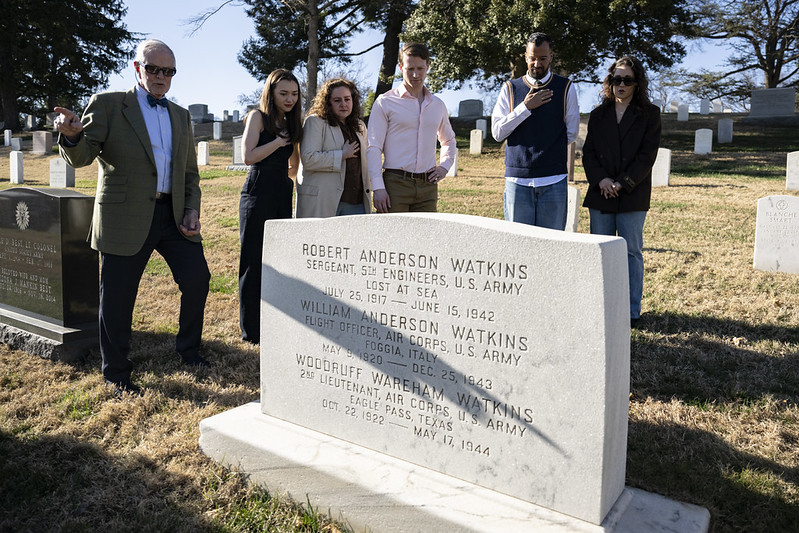
The bright lights and bustling theaters of Broadway might seem unrelated to the mission of Arlington National Cemetery (ANC). But a recent engagement revealed a surprising connection. On March 9, 2026, five actors from the Broadway musical “Operation Mincemeat” visited ANC to honor the real American airman portrayed in one of the show’s songs.
“Operation Mincemeat” is based on the true story of a British covert plan to deceive Nazi Germany about the location of the anticipated Allied invasion of Italy during World War II. The Allies needed Germany to believe they would be invading the island of Sardinia and not Sicily, the actual invasion target. British intelligence operatives concocted a creative and daring plan to plant the dead body of a fake British Marine near the coast of Spain so that the Germans could the obtain papers he carried that revealed the (bogus) plan to invade Sardinia. This trick, if successful, would point the German military to Sardinia, enabling the Allies to face less resistance as they attacked the true target of Sicily. Against all odds, the plan worked and enabled the successful invasion of Sicily.
The musical “Operation Mincemeat” dramatizes the absurdity of this plan through a comedic interpretation of the operation. With a cast of just five actors who each play multiple roles, the musical takes the audience on a surprisingly hilarious romp through the process of planning and launching Operation Mincemeat. The show became a surprise hit in London’s West End and is now playing on Broadway, where it received several Tony award nominations.
But what does a musical about a British World War II intelligence plot have to do with ANC? The answer: a minor character with a catchy song who was a real-life American airman named William Anderson Watkins. Flight Officer Watkins crashed in Spain just a few days before the decoy body washed up, risking the credibility of Operation Mincemeat. The upbeat song, “The Ballad of Willie Watkins,” portrays Watkins as a stereotypically confident American service member and uses the musical stylings of swing and big band to create a uniquely American sound for the character. In reality, Watkins’s story was not at all comical, but one of bravery, dedication to service and tragedy.
Born John William Anderson Harvin in Texas in 1920, William lost his biological father when he was just two years old. His mother Ruth’s second husband, Dudley Warren Watkins, eventually adopted him and his four brothers, setting them all on a path to military service. Dudley Watkins joined the Army in 1917 and went on to have a long career in the Army and later the Air Force, retiring as a colonel. All of his adopted sons (and his biological son) served in the military during World War II. To the Watkins family, service was a family calling.
Eager to get into the fight during World War II, William left the University of Virginia to join the Royal Air Force and transferred to the U.S. Army Air Forces (USAAF) after the United States entered the war. After his crash-landing in Spain in 1943, he escaped and made his way to North Africa, where he connected with his brother John Chester Anderson Watkins of the USAAF’s 325th Fighter Group. William joined that unit and went back into action. For a time, however, his whereabouts were not known, and his family believed him to be missing in action. His stepfather even telegrammed the adjutant general of the War Department, asking for updates about his son’s status. But once the family learned of his survival, their relief did not last long.
On Christmas Day of 1943, William was killed during a fighter mission in Italy. He was just 23 years old. The previous year, his family had already undergone the loss of one son, Sgt. Robert Anderson Watkins, who died on June 15, 1942. Robert had been travelling to attend Officer Candidate School when his ship was torpedoed on its way from Iceland to the United States. His body was lost at sea, never to be recovered. In 1944, one year after William’s death, the family lost yet another son, 2nd Lt. Woodruff (Woody) Wareham Watkins, when he died in an airplane accident. Their mother, Ruth, had endured the almost inconceivable loss of three sons in three consecutive years. In 1944, the Army Air Forces named her Air Force Woman of the year, and at least one of her remaining sons was ordered out of combat.
For his service, William was awarded the purple heart and the Air Medal. But his body was not brought home for burial immediately. As had been the case during World War I, the bodies of American service members who died during World War II were not repatriated until after the war. Families could choose either to bury their loved ones in an overseas American cemetery or to bring them home for burial. The Watkins family chose to bury and memorialize all three boys at ANC.
The story of Flight Officer Williams Watkins and his family offers an incredible testament to one family’s commitment to military service. The musical “Operation Mincemeat,” with its quickly moving plot, is unable to tell this larger story about “Willie Watkins.” Nonetheless, on a recent trip to Washington, DC, five actors from the Broadway company paid tribute to Watkins at his grave in Section 8 of ANC, alongside his descendants.
Williams’s nephew, Tarleton Harvin Watkins II, shared family stories about the man he grew up calling “Uncle Bill,” even though he never knew him. He and his wife Janet recounted how, years later, after the surviving brothers were buried at ANC in neighboring plots near the grave of their parents, the family chose to honor all five brothers on one headstone (even though they were not buried in the same grave). The back of this private marker bears the inscription, “Brothers together again John-Jack-Bob-Bill-Woody.”
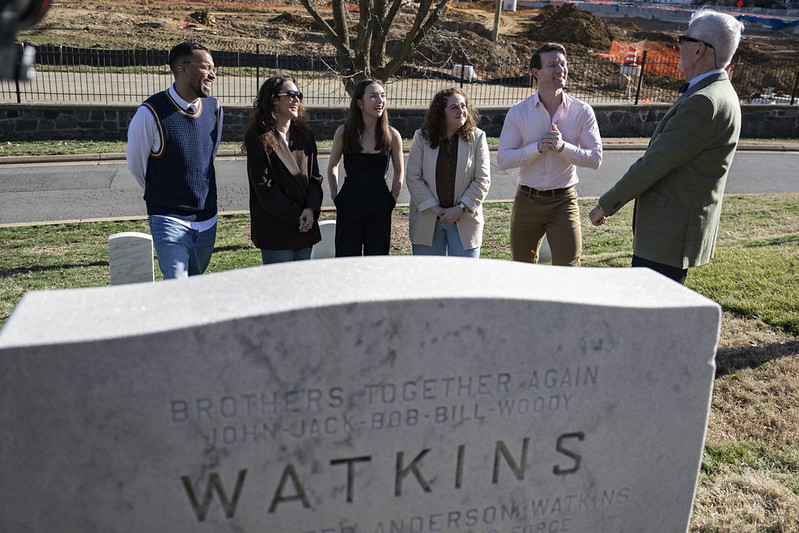
After visiting Section 8, the group went to the Tomb of the Unknown Soldier, where the actors paid homage to the Unknowns and watched the Changing of the Guard ceremony. They learned how the Tomb honors all those without a known grave, including William’s brother, Sgt. Robert Anderson Watkins, who was lost at sea and never recovered. A discussion ensued about how commemoration can take many forms, including through the arts. Every performance of “Operation Mincemeat” memorializes World War II Allied service members by making their stories relevant and exciting to new audiences.
The “Operation Mincemeat” actors took that idea to heart. Jeff Kready, who portrays William in the musical, described the visit to ANC as an “incredibly meaningful and most memorable experience.” He explained that to “be able to visit the grave of William Watkins and meet his family gave a deeper meaning to my portrayal of him on stage, but more importantly, gave me an even greater appreciation of the sacrifices made by our military and their families. Seeing the changing of the guard at the Tomb of the Unknown Soldier moved me to tears; I am grateful for the men and women who serve, and for the chance to pay my respects in such a holy place.”
Actor Amanda Jill Robinson, meanwhile, found personal meaning in her experience. She shared how visiting the Watkins’ family gravesite “added a deeper shade of humanity and gravity to the story we’re telling every night in ‘Operation Mincemeat’… and it makes me infinitely proud of my beloved grandfathers that served in World War II.”
From the West End to Broadway, and soon on a national tour, “Operation Mincemeat” brings this World War II story of deception, desperation and ultimate victory to life for audiences through comedy and song. The musical does not mention ANC onstage. Yet the cemetery, as Willie Watkins’ final resting place, plays a silent role. The musical exemplifies how Arlington’s legacy can be found in unexpected places — and almost always reveals moving stories of service and courage.
► Learn More: Explore our Education Program materials about World War II.