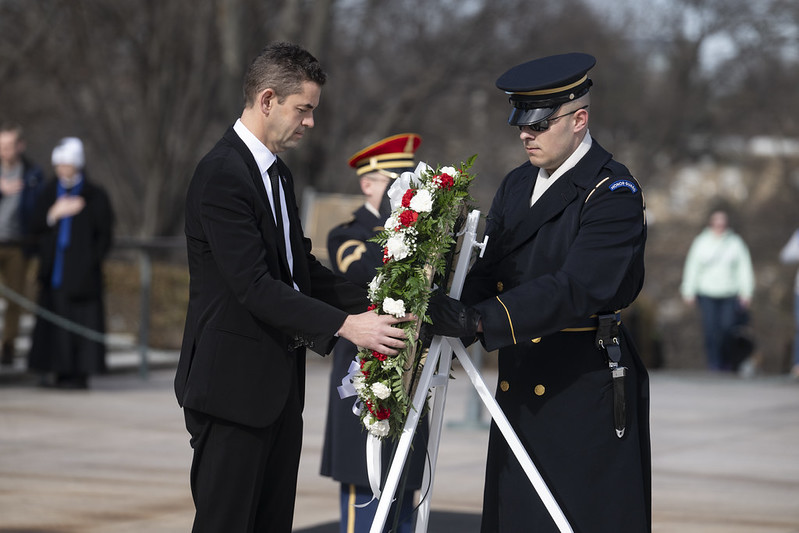
On Jan. 22, 2026, NASA officials, along with colleagues and family members, gathered at Arlington National Cemetery (ANC) for the annual NASA Day of Remembrance ceremony.
Traditionally held on the fourth Thursday in January, the timing of NASA’s Day of Remembrance reflects the anniversaries of three U.S. space program tragedies that occurred between the dates of Jan. 27 and Feb. 1. On Jan. 27, 1967, Apollo 1’s command module experienced a fire during a pre-launch test, killing its three-man crew—who would have been the first human-crewed Apollo flight. The Challenger, with a seven-member crew, exploded soon after liftoff on Jan. 28, 1986. The Columbia, also with a crew of seven, broke up during reentry on Feb. 1, 2003. All three disasters are remembered at ANC with monuments or memorials.
During this year’s ceremony, NASA Administrator Jared Isaacman described the astronauts of Apollo, Challenger and Columbia as “extraordinary men and women who gave their lives for mankind’s greatest achievement.” He added that they accepted the risks of space travel “not for glory, but for the progress of discovery that would advance our knowledge for the benefit of all.”
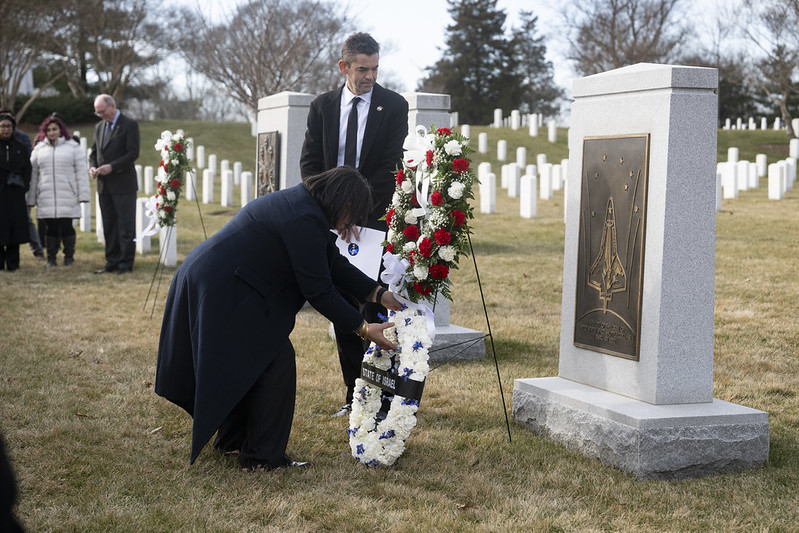
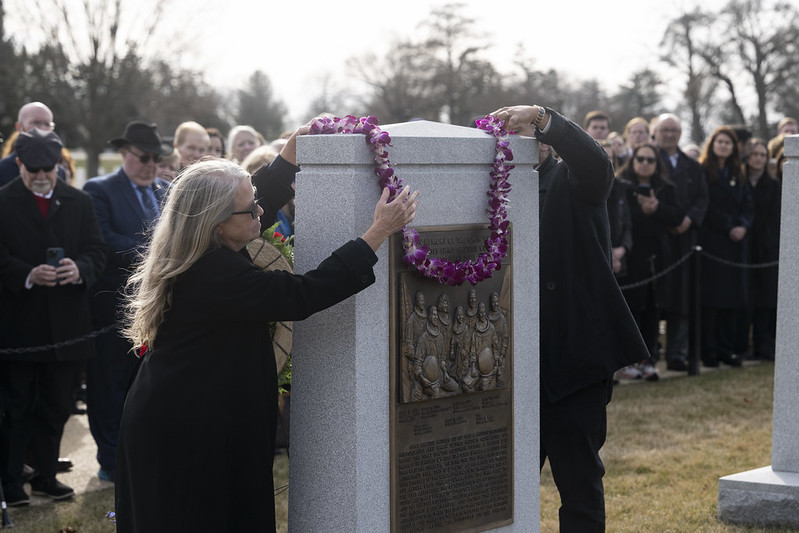
After laying a wreath at the Tomb of the Unknown Soldier, Isaacman laid wreaths at the Space Shuttle Challenger and Columbia Memorials in nearby Section 46. At the Columbia Memorial, Israeli Embassy Minister for Public Diplomacy Sawsan Hasson laid an additional wreath to honor Israeli crewman Ilan Ramon, while two ceremony attendees wrapped a lei on the memorial to honor astronaut William McCool, who spent part of his youth on Guam.
Isaacman emphasized that the Space Shuttle program’s achievements “advanced scientific discovery and proved that the nations of the world could work together beyond Earth with peaceful exploration.” The crews of Challenger and Columbia, he said, would remain part of NASA’s legacy, “a reminder of the courage required to push the boundaries of human knowledge, and for the responsibility carried by those who dare to explore.”
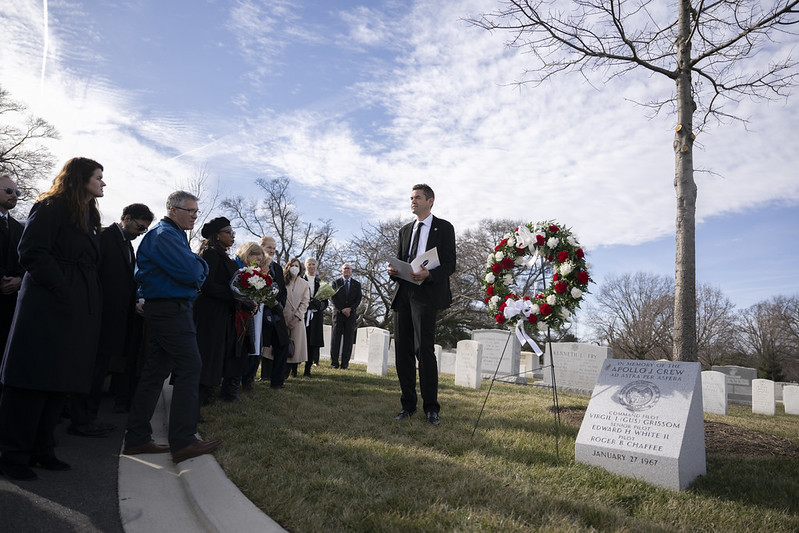
At the Apollo 1 Monument in Section 3, Isaacman laid a wreath and placed flowers at the graves of the two Apollo astronauts buried at ANC, Gus Grissom and Roger Chaffee. These pioneering astronauts, Isaacman explained, enabled the future of spaceflight. “Because of them, safety was strengthened, discipline was sharpened and exploration endured,” he said. “Their spirit and courage live on in the teams and astronauts who carried us to the moon and who will do so again.”
After the ceremony, astronaut and former U.S. Navy Capt. Stephen G. Bowen, a veteran of three Space Shuttle missions, spoke about the risks of spaceflight and the importance of remembering the sacrifices of those who came before him. “Every time we get in a vehicle for our missions, we know we’re putting our faith in the workforce, but even with the most due diligence, there is still a risk,” he said. “There’s no point where you can get complacent.” As he looked out at the rows of headstones, he added, “This is a place of remembrance for the whole country.”
Learn More
► Many astronauts are buried or commemorated at ANC.Our Education Program module, “Explorers: Earth, Air and Space,” offers lesson plans and other resources to understand the Challenger and Columbia tragedies, as well as the history of American exploration from westward expansion through the space age.