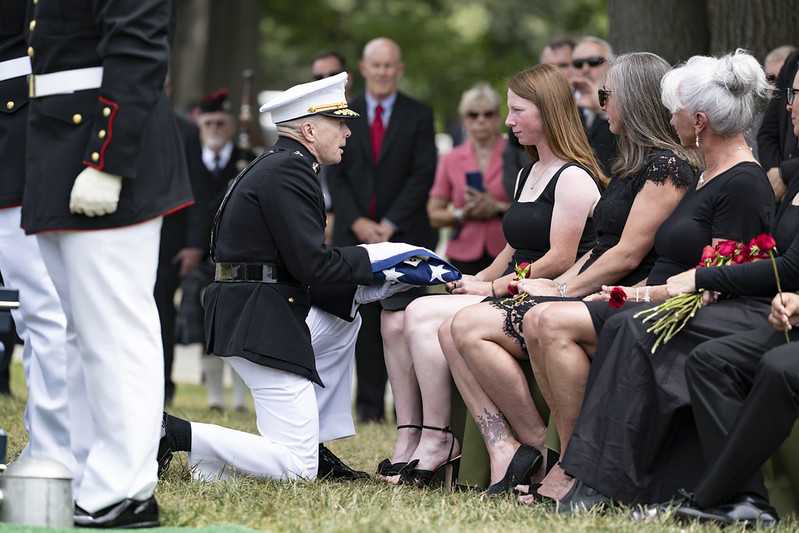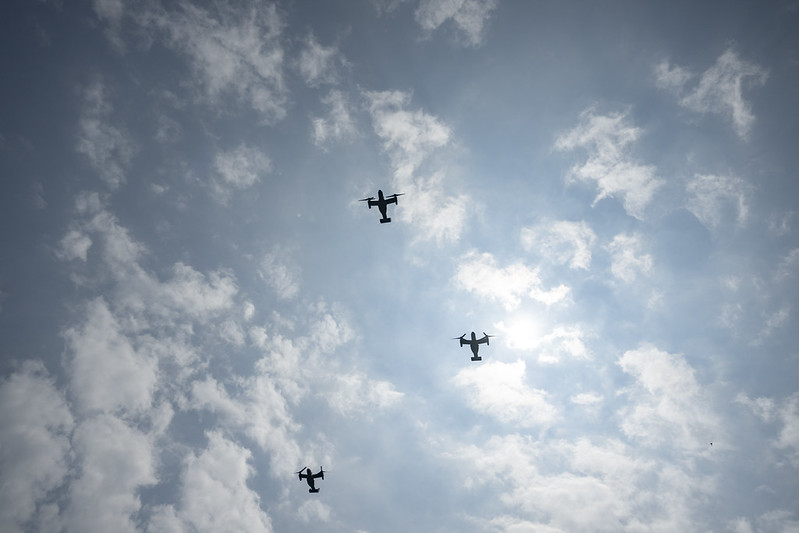
Three V-22 Osprey aircraft roared over Arlington National Cemetery as a final salute to U.S. Marine Corps Lt. Gen. William Keys. More than 100 people attended Keys’ funeral service on July 20, 2026. The full military funeral honors with escort service included a 15-gun salute from the Presidential Salute Battery, a Marine displaying a three-star flag, a caisson detachment, a riderless horse and a bagpiper playing “Amazing Grace.”
Retired Gen. William “Spider” Nyland, who served as the assistant commandant of the Marine Corps, called Keys a great American. Retired Maj. Gen. Harry Jenkins — who served as Marine Corps director, expeditionary warfare in the staff of the chief of naval operations, and who served numerous tours with Keys — called him “the best.”
A 1960 graduate of the U.S. Naval Academy, Keys served 30 years in the Marine Corps. His career spanned leading Marines into combat as a captain in the jungles of Vietnam to commanding as a major general in the deserts of the Middle East.
As a company commander in Vietnam on March 2, 1967, Keys led an attack against a numerically superior North Vietnamese force. He overran the enemy position to his rear, killing six enemy soldiers and destroying a machine gun position. Once the position was taken, he rushed to the front and directed his company’s defense against repeated enemy attacks. Keys’ actions earned him the Navy Cross, the military’s second-highest decoration.
Three days later, when his company came under fire as it traversed a narrow valley, Keys rushed to a vantage point and directed fire at the enemy. When one of his platoons stalled, he led an attack and killed four North Vietnamese soldiers in hand-to-hand combat, earning Keys the Silver Star Medal. In 1972, he served yet another tour in Vietnam as an advisor to a South Vietnamese Marine Division.
Keys rose through the ranks to command the 2nd Marine Division during the 1991 Persian Gulf War. Under his leadership, the division successfully breached Iraqi barriers and minefields along the Kuwaiti border to help liberate Kuwait City during Operation Desert Storm. He retired two years later as the commanding general of II Marine Expeditionary Force and Marine Corps Forces Atlantic, now known as U.S. Marine Corps Forces Command.
After retiring from the Marine Corps, Keys became the president and CEO of a small arms manufacturer. He also served as director of the Marine Corps-Law Enforcement Foundation and as a mentor to Naval Academy midshipmen. He spent his final years at his horse farm in Virginia.
Marines who attended the service spoke highly of their former colleague and boss. Marine Corps Deputy Commandant for Plans, Policies and Operations Lt. Gen. Jay Bargeron presented the flag to Keys’ daughter, Lizzie Keys. Bargeron, who had served as a lieutenant under Keys during the Persian Gulf War, said, “It really is an honor to be here for someone with his proven service and such a great example of what a Marine should be.”
Chief Warrant Officer 5 Ray Grundy, who served under Keys in the 2nd Marine Division during the Persian Gulf War, described Keys as an approachable, courageous leader and humanitarian. “He had no airs about him; he was a genuine person,” Grundy remarked. “He’s one of the heroes of my time in the Marine Corps.”
Looking out over the large gathering of mourners, he added, “He will never be forgotten, and you can tell by the turnout. This is like a family reunion.”