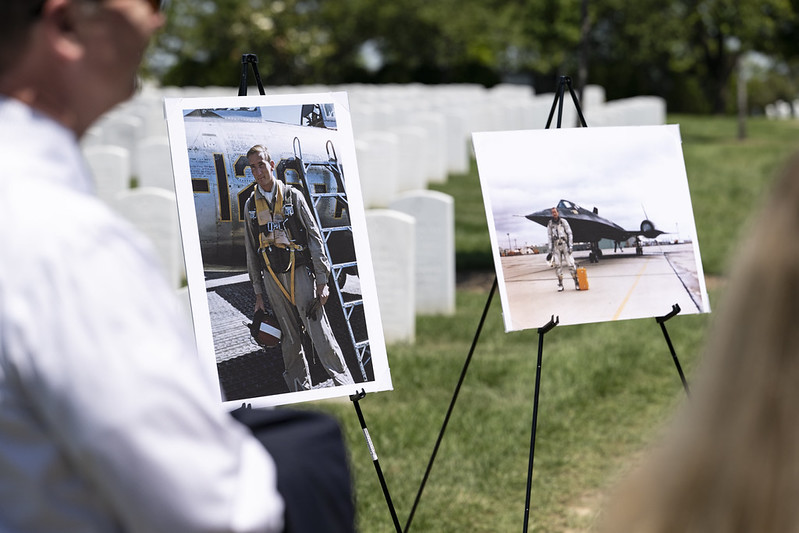
On Dec. 22, 1964, Robert Gilliland Sr. became the first person to pilot the supersonic SR-71 Blackbird, one of the fastest crewed aircraft ever built. He would go on to test almost every SR-71 that came out of the factory, logging more test flight hours at Mach 3 than any other pilot in the world. Almost 62 years after that first flight, the high-flying pilot was laid to rest at Arlington National Cemetery.
Scientists, engineers and high-ranking military officers attended Gilliland’s secret maiden voyage of the Blackbird. But he also arranged for some special guests to witness history. A few nights before the flight, he instructed his wife Mary to park her car near one of Lockheed Martin’s Advanced Development Program facilities (known as “Skunk Works”) in Palmdale, California, so that she could witness his takeoff. He also wanted to make sure that if he had to eject and the aircraft crashed, she and their children would not be near the “fireball.”
When the morning arrived, Mary packed the couple’s two children, Robert Jr. and Anne, into the family car and parked at the designated spot. She watched with binoculars as Gilliland sped down the runway and took off. The Blackbird streaked by with a roar. Robert Jr. remembered his reaction. “It was so thunderously loud that it scared the bejesus out of me,” he later recalled. He looked up at his mother and noticed tears streaming down her face. “It was like she was willing the airplane off the ground,” he said. The flight was a success.
Gilliland, from Memphis, Tennessee, entered the U.S. Naval Academy during World War II and graduated in 1949, yet he was offered a commission into the newly established Air Force. He flew fighter jets during the Korean War and, after the war, flew the supersonic F-104 jet as a test pilot. He successfully made five dead-stick landings, meaning that the aircraft had lost all engine power before landing. His skills caught the eye of Skunk Works engineer Kelly Johnson, who asked him if he would like to fly an aircraft that could go faster, further and higher than the F-104. Gilliland agreed and joined Lockheed Martin as a civilian, serving as Johnson’s chief test pilot for the Blackbird and its variations.
When Robert Gilliland Jr. asked his father what it was like to fly at Mach 3.2, he explained that he could sense the initial increase in speed, but as the Blackbird climbed and accelerated, points of spatial reference diminished and it felt “like driving a Cadillac.” He had to check the instruments every three seconds. At such extreme speed and altitude, he said, “there’s no daydreaming out the window.”
At Gilliland’s funeral service on June 4, 2026, U.S. Air Force Chaplain (Capt.) Kevin Pew described Gilliland as a devoted father and grandfather, a patriot “and one of the most extraordinary aviators our nation has ever known.”
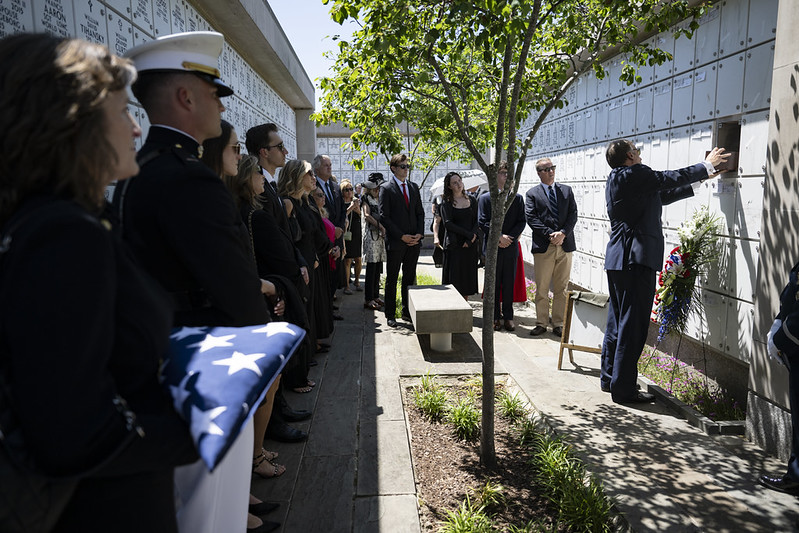
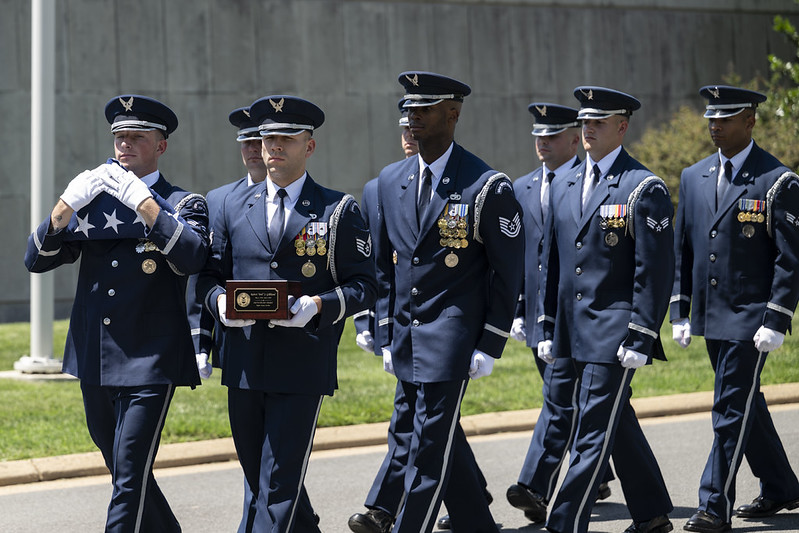
After the service, which included an Air Force honor guard, a firing team firing three volleys and a bugler sounding Taps, the family brought Gilliland’s urn to Columbarium Court 9 while a bagpiper played traditional Scottish songs. Once his urn had been placed in its niche, family and friends took turns saying their last goodbyes. Anne Gilliland Hayes said that touching her father’s urn brought back “a thousand wonderful memories of our dad.”
During the service, passenger jets roared overhead as they departed Ronald Reagan National Airport — a fitting backdrop for a pilot who served his country by flying higher and faster than most people could even dream.